How to Automate Security & Compliance Questionnaires with Fides Rating

Security questionnaires, vendor due diligence (DDQs), customer audits, regulatory requests… they all ask the same thing in different words: prove your security and compliance posture, fast.
For CISOs, compliance officers, and GRC teams, the problem isn’t “answering” the questions. The problem is doing it repeatedly, consistently, and with evidence—without burning weeks in copy-paste, chasing SMEs, and rebuilding the same narratives every quarter.
This article explains a practical approach to automate and accelerate questionnaire responses using Fides Rating—while keeping human control, traceability, and audit readiness.
Why security questionnaires are a recurring bottleneck
Security and compliance questionnaires are now a standard step in:
- customer onboarding and renewals (enterprise procurement)
- third-party risk management (TPRM)
- audits and internal control campaigns
- regulatory-driven evidence requests (e.g., DORA/NIS2 readiness programs)
Manual handling creates three structural risks:
- Time drain: teams lose days rebuilding answers from scratch.
- Inconsistency: different people respond differently to the same question.
- Weak defensibility: answers are not linked to clear, versioned evidence.
The result is predictable: more follow-up questions, longer sales cycles, and last-minute audit stress.
What “automation” should mean in a regulated context
In compliance, automation cannot mean “press a button and send.”
It must mean:
- draft faster from approved sources
- standardize across teams and entities
- attach proof (document, section, version)
- keep humans in control (review and approval workflow)
- reuse continuously as evidence evolves
That’s the product philosophy behind Fides: augment the team—don’t replace it.
How Fides Rating automates questionnaire responses (without losing control)
Fides combines three layers that matter in enterprise GRC:
1) A centralized evidence base
Your approved documentation becomes a single source of truth:
policies, procedures, risk registers, incident runbooks, BCP/DR plans, test reports, supplier contracts, prior validated answers.
2) Evidence-grounded AI
Fides uses retrieval-augmented generation (RAG) to:
- retrieve the most relevant passages from your evidence base
- draft a response based on those sources
- keep outputs aligned to what you can actually prove
3) Human validation workflow
Drafts are reviewed, edited, approved, and versioned.
This makes answers consistent and defensible—especially when you respond under time pressure.
A practical 7-step workflow to answer questionnaires “10x faster” with Fides
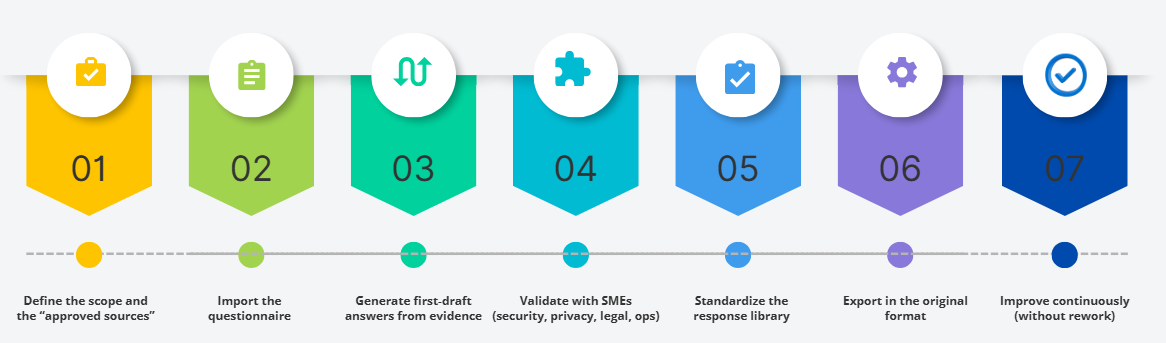
Step 1 — Define the scope and the “approved sources”
Start small: pick one recurring questionnaire (customer DDQ or internal audit pack).
Agree on what counts as authoritative evidence: “approved policies,” “latest pentest,” “BCP test report,” etc.
Step 2 — Import the questionnaire
Upload your questionnaire (typical spreadsheets/templates). Fides structures it so each question can be mapped to evidence and previous answers.
Step 3 — Generate first-draft answers from evidence
Fides drafts responses by extracting relevant evidence and generating consistent narratives.
You get a baseline quickly—without starting from a blank page.
Step 4 — Validate with SMEs (security, privacy, legal, ops)
Assign reviewers to the sections they own. The goal is not to rewrite everything—just to confirm accuracy, add nuance, and approve.
Step 5 — Standardize the response library
Turn validated answers into reusable “golden answers” tied to controls and evidence. This is where the compounding effect starts.
Step 6 — Export in the original format
Deliver the completed questionnaire in the same format procurement expects—clean, consistent, and evidence-ready.
Step 7 — Improve continuously (without rework)
When a policy changes or a new test report is produced, you update the evidence once.
Future questionnaires get updated answers automatically through reuse + versioning.
Best practices that make automation actually work
Build an “evidence map,” not a document dump
Automation fails when the repository is unstructured. Start with:
- governance policies (security, access, supplier risk)
- operational runbooks (incident, vulnerability, BCP/DR)
- test evidence (tabletops, DR tests, scans, pentests)
- third-party controls (contracts, SLAs, attestations)
Enforce consistency rules
Define standard wording for recurring topics: encryption, IAM/MFA, logging, vulnerability management, backups, RTO/RPO, access reviews.
Treat questionnaires as a product process
Use the same rigor as product delivery: ownership, review cycle, versioning, release notes for major changes, and a single “final export” gate.
Typical use cases for Fides Rating
Fides is built for high-frequency, high-stakes compliance work:
- Customer security reviews & procurement DDQs
- ISO 27001 evidence packs (audit preparation and surveillance cycles)
- DORA / NIS2 readiness reporting (controls, evidence, gap tracking)
- Internal audit requests (repeatable evidence packages)
SaaS, On-Prem, and sovereignty: deployment that fits regulated environments
Many regulated organizations require strict data handling and infrastructure constraints. Fides supports:
- SaaS for speed and operational simplicity
- On-premise for environments requiring stronger infrastructure control
- A sovereign approach aligned with EU expectations (data residency and regulated-market requirements)
This matters in procurement: it reduces friction during vendor security reviews and supports stronger trust conversations.
FAQ: common questions from CISOs and Compliance Officers
Does Fides replace my team?
No. It accelerates drafting and evidence retrieval. Your team reviews and approves everything that leaves the organization.
Will answers stay consistent across multiple questionnaires?
Yes—once you build a validated answer library tied to evidence, reuse becomes the default.
What if we don’t have the evidence yet?
Fides flags gaps so you can assign owners and fix what’s missing instead of guessing.
Is it only for ISO 27001?
No. It supports questionnaires and evidence mapping across regulatory and GRC needs (including DORA/NIS2-style reporting and customer due diligence).
Make questionnaires a controlled, repeatable process
Questionnaires won’t disappear. The winning strategy is to turn them into a repeatable workflow where:
- evidence is centralized,
- answers are drafted fast,
- validation is structured,
- exports are consistent,
- and improvements compound over time.
If you want to reduce questionnaire fatigue and stay audit-ready, Fides Rating is built for exactly that.
Request a demo and bring one of your recurring questionnaires—we’ll show how to generate evidence-backed responses in a controlled workflow.